Welcome to the Mathematical World!
Werner Heisenberg
Father of Quantum Mechanics
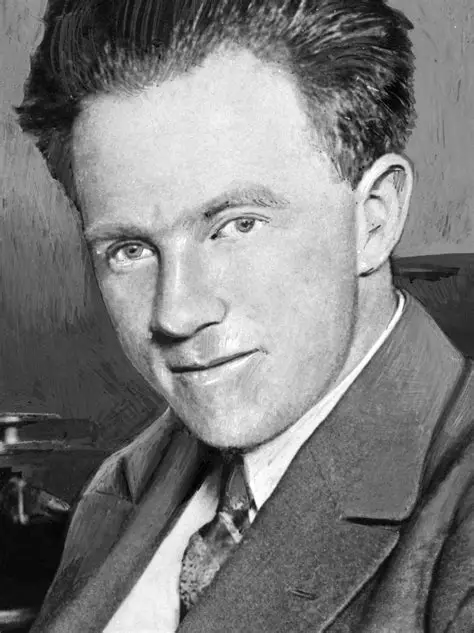
Werner Heisenberg (1901–1976) was a German theoretical physicist and one of the key pioneers of quantum mechanics. Born in Würzburg, Germany, Heisenberg made groundbreaking contributions that reshaped our understanding of the atomic and subatomic world. He is best known for formulating the Heisenberg Uncertainty Principle, which established fundamental limits on the precision of measurements in quantum systems.
Early Life and Education
Heisenberg studied physics at the University of Munich and the University of Göttingen under prominent physicists such as Arnold Sommerfeld and Max Born. By his early twenties, he was already contributing to the emerging field of quantum theory, challenging classical notions of determinism and predictability in physics.
Matrix Mechanics
In 1925, Heisenberg developed matrix mechanics, the first complete formulation of quantum mechanics. This approach described the behavior of electrons in atoms using matrices rather than classical trajectories, focusing on observable quantities like spectral lines rather than unobservable orbits.
Heisenberg Uncertainty Principle
Heisenberg formulated the Uncertainty Principle in 1927, which states that certain pairs of physical properties, such as position \(x\) and momentum \(p\), cannot be simultaneously measured with arbitrary precision:
\[ \Delta x \, \Delta p \geq \frac{\hbar}{2} \]where \( \Delta x \) is the uncertainty in position, \( \Delta p \) is the uncertainty in momentum, and \( \hbar \) is the reduced Planck constant. This principle is a cornerstone of quantum mechanics and signifies that the microscopic world fundamentally differs from classical intuition.
Other Contributions
Heisenberg also made significant advances in:
- Quantum field theory
- Nuclear physics and particle physics
- The theory of ferromagnetism
During World War II, he led Germany’s nuclear research program, although the project never achieved a functional atomic bomb. His role during this period remains a subject of historical discussion.
Legacy
Heisenberg’s work profoundly influenced modern physics. His theoretical innovations underpin quantum mechanics, quantum field theory, and many technologies such as semiconductors, lasers, and MRI machines. In 1932, he was awarded the Nobel Prize in Physics for the creation of quantum mechanics, and his name remains synonymous with the principles governing the microscopic universe.

All rights reserved by the Mathematical Unity
Contact: +8801400044645
Email: mathematicalhorse1453@gmail.com
Our Discord Server: Mathematical Unity [Ulus Riyadiyat]